
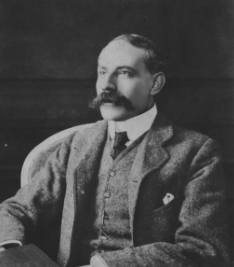
Sir Edward William Elgar was an English composer, among whose best-known compositions are orchestral works including the Enigma Variations, the Pomp and Circumstance Marches, concertos for violin and cello, and two symphonies.Elgar’s father owned a music shop and was a church organist who taught his son piano, organ, and violin; apart from this instruction, Elgar was basically self-taught as a musician. Edward Elgar was born in Worcestershire and lived in and around Malvern and the Malvern Hills for many years. It was the Malvern Hills that inspired many of his well-known compositions. From age 55 he lived in view of the Malvern Hills and was routinely seen cycling around the surrounding countryside and village lanes during that time.
At the age of 16, the composer became a freelance musician and for the remainder of his life never took a permanent job. He conducted locally, performed, taught, and composed, scraping by until his marriage to Caroline Alice Roberts, a published novelist of some wealth, in 1889.
In 1899, Elgar composed one of his best-known works, the “Enigma” Variations, Op. 36, which catapulted him to fame. In 1899 Elgar wrote an orchestral piece called the Enigma Variations. There is a main tune, and then a series of variations on the tune. Each variation describes one of his friends, but he did not say which friends they were: he only put their initials or nickname at the top of each variation. This is why the piece is an enigma (a “puzzle” or “secret”). People have managed to work out who each friend was, but the meaning of the main tune is still a puzzle. This music made Elgar very famous.
Elgar’s most popular piece is the first of his Pomp and Circumstance marches. It has the tune which is sung to the words “Land of Hope and Glory” . It became an unofficial second national anthem for Britain and the audience always join in singing it at the Last Night of the Proms.
Elgar suffered a blow when Jaeger (the “Nimrod” of the “Enigma” Variations) died in 1909. The composer’s productivity dropped, and the horrors of World War I deepened his melancholic outlook.
In 1919 Elgar wrote the masterly Cello Concerto in E minor, Op. 85, whose deep feeling of sadness and impending loss surely relates to the final illness of his faithful wife Alice, who died in 1920. In the early 1930s, Elgar set to work on a third symphony, left unfinished at his death in 1934.
Another version of Nimrod, arranged here for cellos
March no 1 (Pomp and Circumstance)
1st movement Cello concerto
 Stay Safe
 Statutory
Reporting
Statutory
Reporting
Leave a Reply